How Do Taste, Fat, Salt, Sugar and Texture Change Our Food Experience?
Deep Article4 min read
The same ingredients, recombined in specific ratios and forms, don't just change how food tastes. They can influence how enjoyable — and how difficult to stop eating — a food may feel.
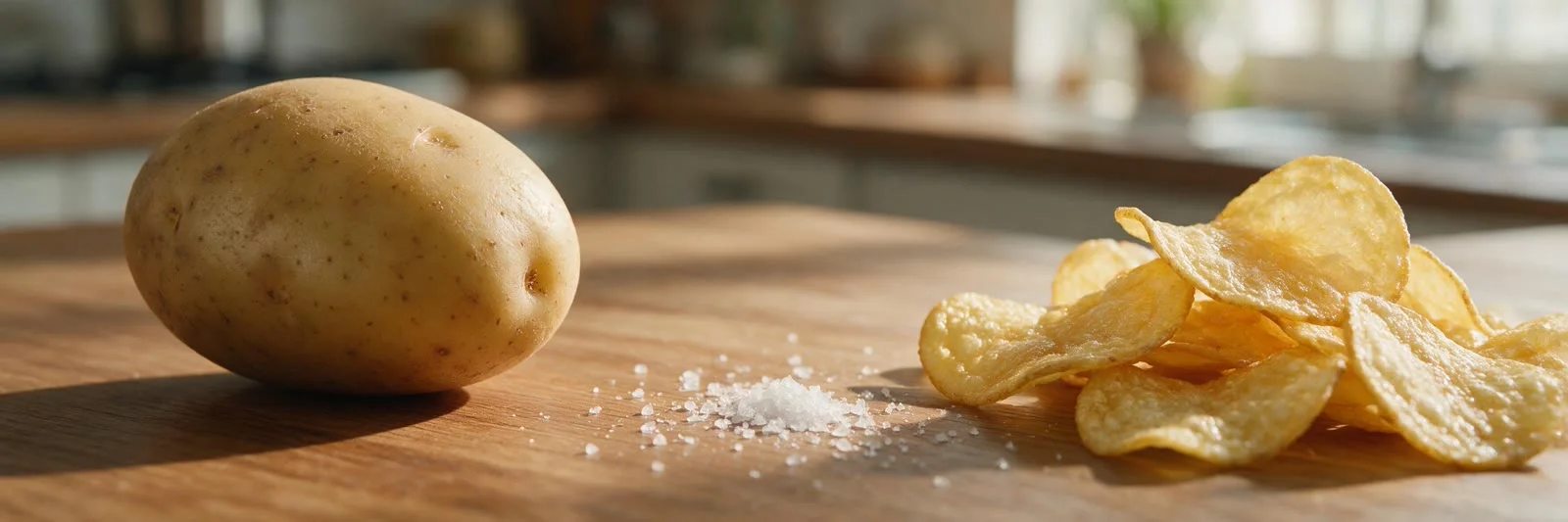
A whole potato and a bag of potato chips share almost the same starting ingredient. One of them is easy to stop eating. The other, for most people, isn’t. The difference isn’t the potato — it’s everything done to it afterward, and food science can now describe exactly what that “everything” consists of.
The hyperpalatable formula
There’s a formal, quantitative definition of the foods that are hardest to stop eating, and it isn’t just “junk food” as a vibe. A 2019 study published in Obesity defined hyperpalatable foods using specific nutrient thresholds. A food qualifies if it hits any one of three combinations:
- Fat + sodium: more than 25% of calories from fat, and sodium at or above 0.30% of the food’s weight
- Fat + sugar: more than 20% of calories from fat, and more than 20% of calories from simple sugar
- Carbohydrate + sodium: more than 40% of calories from carbohydrate, and sodium at or above 0.20% of the food’s weight
The researchers applied that definition to the USDA’s Food and Nutrient Database for Dietary Studies — a database of foods commonly consumed in the United States — and found that 62% of the foods in that specific database met at least one threshold. That’s a statement about how foods in the U.S. food supply tend to be formulated, not a claim about all food everywhere. Still, within that context, the mechanism behind “I couldn’t stop eating that” usually isn’t one standout ingredient — it’s a precise ratio of fat, sugar, carbohydrate and sodium, combined specifically enough to keep triggering reward before the brain’s normal fullness signal, sensory-specific satiety, has a chance to catch up.
Why fat carries flavor
Fat isn’t just a texture ingredient — it’s part of how flavor gets delivered. Aroma compounds vary widely in their chemistry, but many are lipophilic: they dissolve more readily into fat than into water. For those compounds, the amount of fat in a dish directly affects how they’re released and perceived — fat can slow their release, changing not just intensity but the timing of flavor, a longer build instead of one immediate hit.
Fat also does much of the work behind what food scientists call mouthfeel: viscosity, creaminess, smoothness, how a food coats the mouth. In dairy products specifically, research has found that the perceived “creaminess” of a food is driven at least as strongly by the release of fat-soluble aroma compounds as by its actual thickness — so the experience of creaminess isn’t only about texture. It’s shaped by smell as much as by touch.
Salt’s real job isn’t saltiness
Salt’s most interesting effect isn’t the salty taste itself — it’s what salt does to everything else on the plate. A landmark study found that sodium suppresses bitterness more strongly than it does other tastes, and in doing so makes sweetness, sourness and umami more noticeable by comparison. Sodium ions appear to raise the activation threshold of specific bitter-taste receptors, effectively turning bitterness down at the source, in the mouth, before the brain even processes it.
That’s the actual reason a pinch of salt shows up in dark chocolate, coffee and baked goods — not to add saltiness, but to mute the bitter notes so the sweetness underneath reads as more intense. Salt is functioning as an editor of every other flavor in the dish, which is also why it appears in two of the three hyperpalatable-food combinations above: it isn’t just a flavor, it’s an amplifier.
The crunch you hear is part of the taste
Texture reaches the brain through more than touch. In a now well-known 2004 Oxford study, researchers had people bite into potato chips while secretly altering the volume and pitch of the crunch sound they heard through headphones. Chips with a louder, higher-pitched crunch were rated 15% fresher on average than the exact same chips with a duller sound — nothing about the chip itself changed, only the audio. The finding later won an Ig Nobel Prize, but it points to something real: your ears are grading a food’s freshness in real time, independently of what’s actually happening in your mouth.
The experience is designed, not accidental
None of these effects work in isolation, and that’s the actual point. Fat carries and times the flavor. Salt edits out the bitterness and turns up everything pleasant. Sugar and fat together cross a measurable threshold that keeps a food rewarding well past the point most foods would stop being interesting. Crunch adds a freshness signal your ears deliver before your brain has finished chewing.
Food doesn’t taste the way it does by accident. Taste, fat, salt, sugar and texture are levers — and modern food formulation pulls several of them at once.
The next time one food is easy to put down and another isn’t, the difference usually isn’t willpower. It’s how many of these levers were pulled, and how precisely.