Why Does Homemade Food Spoil Faster Than Packaged Food?
Deep Article7 min read
Same ingredients, wildly different lifespans. The gap isn't about what's inside the food — it's about the invisible system built around it.
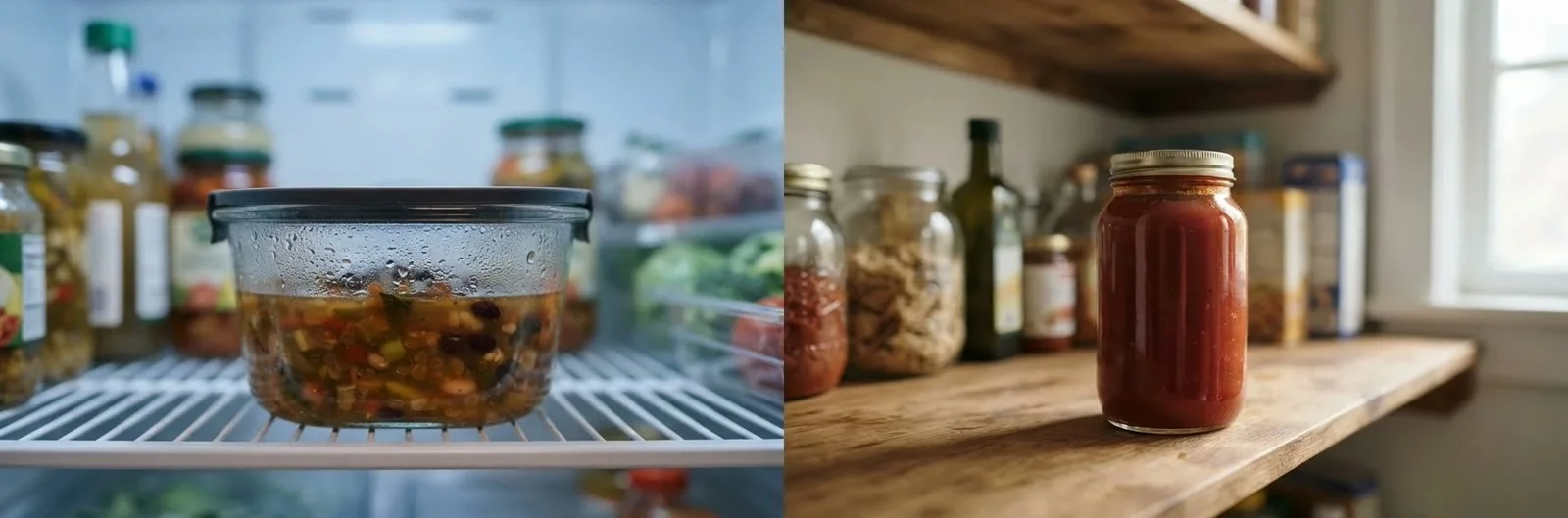
A pot of homemade soup goes into the fridge on Sunday night. By Wednesday, it smells faintly off. An unopened shelf-stable sauce, meanwhile, can sit in a cupboard for months — or years — without refrigeration. Both are, broadly, “food.” So why does one live on borrowed time while the other barely notices the calendar?
It’s tempting to chalk this up to “processed” versus “natural.” That story is mostly wrong. Shelf life isn’t a property food simply has — it’s something engineered, deliberately, by controlling the conditions that let food fall apart. A home kitchen usually isn’t doing that engineering, not because it’s careless, but because it was never built to.
Spoilage is a race, not a single event
From the moment food is harvested, processed, or cooked, it’s racing against a handful of forces trying to take it apart. Microorganisms — bacteria, yeasts, and molds — are the obvious culprits; some just make food taste or smell bad, while others are pathogens that can make you sick without changing how the food looks or smells at all.
Water activity is the one people overlook, because it isn’t the same as moisture content. Written aw, it measures how much water in a food is actually available to microorganisms, not how wet the food feels. Salt, sugar, and drying can all bind up water so it’s no longer usable — which is why lowering water activity, not just moisture, is often the real preservation lever.
Temperature strongly influences microbial growth, with many foodborne bacteria multiplying rapidly between 40°F and 140°F (4°C–60°C) — commonly called the “danger zone” — and in some cases doubling in as little as 20 minutes. pH is another lock on the door: Clostridium botulinum, the organism behind botulism, can’t grow or produce toxin at a pH of 4.6 or below. Oxygen feeds some spoilage organisms and drives purely chemical decay too, like browning or staling. And time is the quiet multiplier behind all of it — these factors accumulate rather than act instantly.
None of this happens in isolation. These factors interact, and that interaction is the key to understanding shelf life.
The refrigerator doesn’t stop spoilage
A common assumption is worth correcting here: putting food in the fridge doesn’t switch spoilage off. A refrigerator isn’t a pause button — it’s closer to a slow-motion setting. Cold temperatures slow microbial growth and chemical reactions; they don’t stop either one completely. Some organisms, like Listeria monocytogenes, can still grow slowly even at standard refrigerator temperatures. A homemade dish sitting in the fridge for a week isn’t frozen in time — it’s just decaying more slowly than it would on the counter, with the same forces above still quietly at work.
So what makes packaged food last so long?
Packaging itself usually isn’t the mechanism — it’s the last step, protecting stability that was already engineered before and during processing. Manufacturers lean on a handful of major barriers:
- Heat — pasteurization applies mild heat (milk, for instance, at 161°F/72°C for 15 seconds) to reduce pathogens without full sterilization; the product still needs refrigeration. Sterilization goes further, using high heat under pressure — canned low-acid foods are typically processed at 240°F–250°F — to achieve commercial sterility, the level of microbial control that lets properly processed canned foods remain shelf-stable for years.
- Moisture control — freezing makes water unavailable as ice and slows activity through cold; drying removes water outright, directly lowering water activity. Different mechanisms, same target.
- Acidity and preservatives — acids and approved preservatives make the environment less hospitable to microorganisms, whether by lowering pH, reducing water activity, or inhibiting microbial processes directly. Not every shelf-stable product is full of “preservatives” in the chemical-additive sense; many rely on heat, drying, or acidity instead.
- Packaging and oxygen control — vacuum sealing and modified atmosphere packaging (MAP) remove or replace oxygen, slowing oxidation and oxygen-dependent growth. Well-designed MAP can significantly extend shelf life compared with conventional packaging.
No single one of these usually does all the work alone.
Hurdle technology: small barriers beat one big one
Food scientists call this layered approach hurdle technology, a concept the German researcher Lothar Leistner formalized in the 1970s: combine several milder “hurdles” — heat, acidity, reduced water activity, refrigeration — so no microorganism can clear all of them at once. A deli-style sauce might be mildly acidified, gently pasteurized, and refrigerated; no single step fully protects it, but together they’re hostile on multiple fronts — often gentler on quality than one extreme treatment would be. Shelf life, in other words, isn’t a number a food “has.” It’s a designed outcome of formulation, processing, packaging, and storage working as one system.
Why a factory can promise what a kitchen can’t
This isn’t about skill. A commercial facility can control starting microbial load, processing precision, cooling speed, and storage temperature far more consistently than a home kitchen ever could — a blast chiller drops large volumes through the danger zone in minutes, something no stockpot on a counter can match. That consistency, not any single ingredient or additive, is what industrial shelf life is really built from. A home kitchen is built around flexibility instead — different foods and quantities, by hand, every time — which is exactly what makes an industrial shelf life impractical to reproduce at home.
Shelf life, safety, and nutrition are different things
A longer shelf life doesn’t make a food more nutritious, or even meaningfully safer while both are fresh — it mainly means the food was engineered to resist deterioration longer. A shorter shelf life doesn’t mean homemade food was unsafe to begin with; it just wasn’t built with the same barriers.
It also helps to separate quality deterioration from microbial spoilage. Bread going stale, greens wilting, a sauce separating — these can happen well before food becomes microbiologically unsafe. The reverse is more dangerous to forget: some pathogens and toxins don’t change how food looks, smells, or tastes at all. “It still seems fine” is a statement about quality, not safety.
Where homemade leftovers actually go wrong
Many home food-safety problems trace back to a few avoidable gaps: slow cooling of large volumes (a big pot holds heat, so its center can sit in the danger zone for hours even in the fridge); too much time at room temperature — beyond two hours, or one hour above 90°F — since refrigeration afterward slows further growth but doesn’t undo growth that already happened; repeated reheating and recooling, which reopens that window each time; and contamination from hands or utensils, like a spoon that touched raw chicken and then a finished dish.
Two examples show how differently foods can behave. Cooked rice: Bacillus cereus spores can survive cooking and, if the rice sits at room temperature, germinate and produce a toxin that reheating won’t destroy. Cut vegetables spoil faster than whole ones for a different reason entirely — cutting increases surface area and releases moisture and nutrients, speeding up both microbial growth and purely chemical decay like browning.
How to actually extend the life of homemade food
- Refrigerate leftovers within two hours of cooking (one hour above 90°F/32°C).
- Divide large batches into shallow containers, no more than about two inches deep.
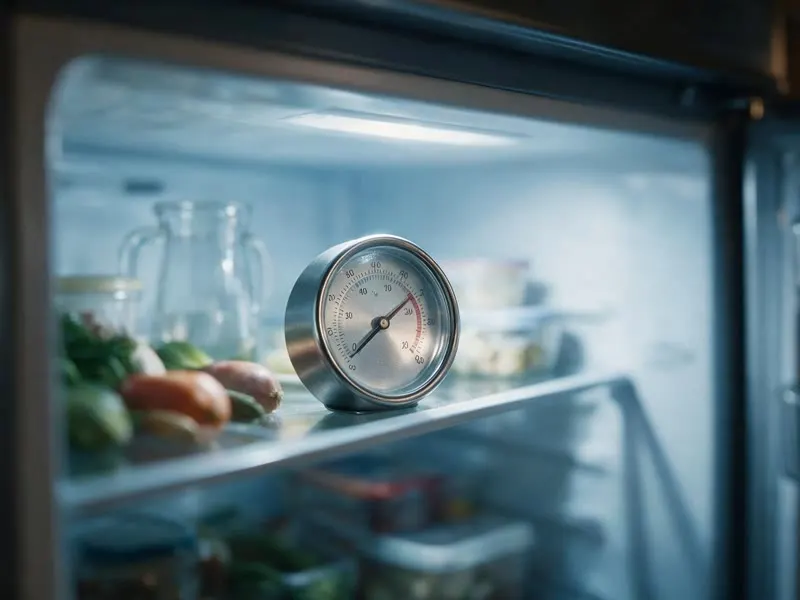
- Keep the fridge at 40°F (4°C) or below — check it with a thermometer, not the dial.
- Cover food during storage, and use clean utensils for serving.
- Use most cooked leftovers within 3 to 4 days.
- Reheat leftovers to 165°F (74°C) throughout, not just warm at the edges.
The takeaway, back in your kitchen
None of this makes packaged food superior or homemade food risky — it just reframes the question. Shelf life isn’t a fact baked into food the moment it’s made; it’s a specification, built by stacking heat, acidity, moisture control, and oxygen exclusion into a system designed to slow decay.
Shelf life isn’t simply something food has. It’s something food scientists design.
Next time a homemade dish turns sooner than a packaged product two shelves over, the difference usually isn’t the food itself — it’s the preservation system, or lack of one, built around it.