The 4°C Rule: Why Your Fridge Temperature Matters More Than You Think
Deep Article5 min read
A few degrees inside your fridge can change how fast bacteria multiply. Here's what the number actually means — and how to check it at home.
Do you actually know how cold your fridge is right now? Not the dial setting — the real temperature, in degrees. Most people don’t, and most people have never checked. The dial just gets set once, somewhere in the middle, and forgotten.
That small gap in knowledge matters more than it seems. A few degrees of difference can significantly change how quickly bacteria multiply — Sweden’s National Food Agency, Livsmedelsverket, notes that food can have roughly twice the shelf life at 4°C compared with 8°C.
The number behind the rule
Food safety agencies broadly agree on the target, even though the exact recommendation varies slightly by country. The FDA recommends 4°C (40°F) or below, while WHO guidance recommends keeping cold food below 5°C. Livsmedelsverket also recommends setting the refrigerator to 4°C. The message is essentially the same: don’t just aim for “cold” — aim for a measured temperature of around 4°C or below.
That precision exists because of what happens as temperatures rise. Food-safety guidance commonly describes roughly 5°C to 60°C as a temperature range in which microorganisms can multiply rapidly. WHO advises keeping food below 5°C because refrigeration slows microbial growth, although it does not stop it completely.
The FDA notes that some foodborne bacteria can double in number in as little as 20 minutes at room temperature under favourable conditions. That means food left on the counter for a couple of hours can, in theory, go through several rounds of bacterial multiplication before anything looks or smells different.
At or below 4°C, bacterial growth slows considerably for many microorganisms. That is the purpose of refrigeration: not to sterilize food, but to slow microbial growth and give you more time to use it safely. Some bacteria are the exception, though — WHO notes that certain microorganisms can still grow below 5°C. Listeria monocytogenes is a good example: unlike most foodborne bacteria, it can keep growing slowly at refrigerator temperatures (the FDA notes it can grow as low as about −0.4°C), which is one reason chilled ready-to-eat foods still have a limited shelf life even when the fridge is running correctly.
Why the dial can’t be trusted
Here’s the part many people don’t realize: the number on your fridge dial — 1 to 5, for example — usually isn’t a thermometer reading. It is a relative temperature setting, and the actual temperature can vary depending on the refrigerator model, how full it is, how often the door opens, and where inside the refrigerator you measure.
The door is generally one of the warmer parts of the fridge because it is exposed to room-temperature air every time the door opens. Milk and other highly perishable foods are therefore generally better kept further inside the main refrigerator compartment rather than in the door.
A fridge that feels cold enough can still be running at 7°C or 8°C in practice, without the food necessarily looking or smelling different.
What this actually means for you
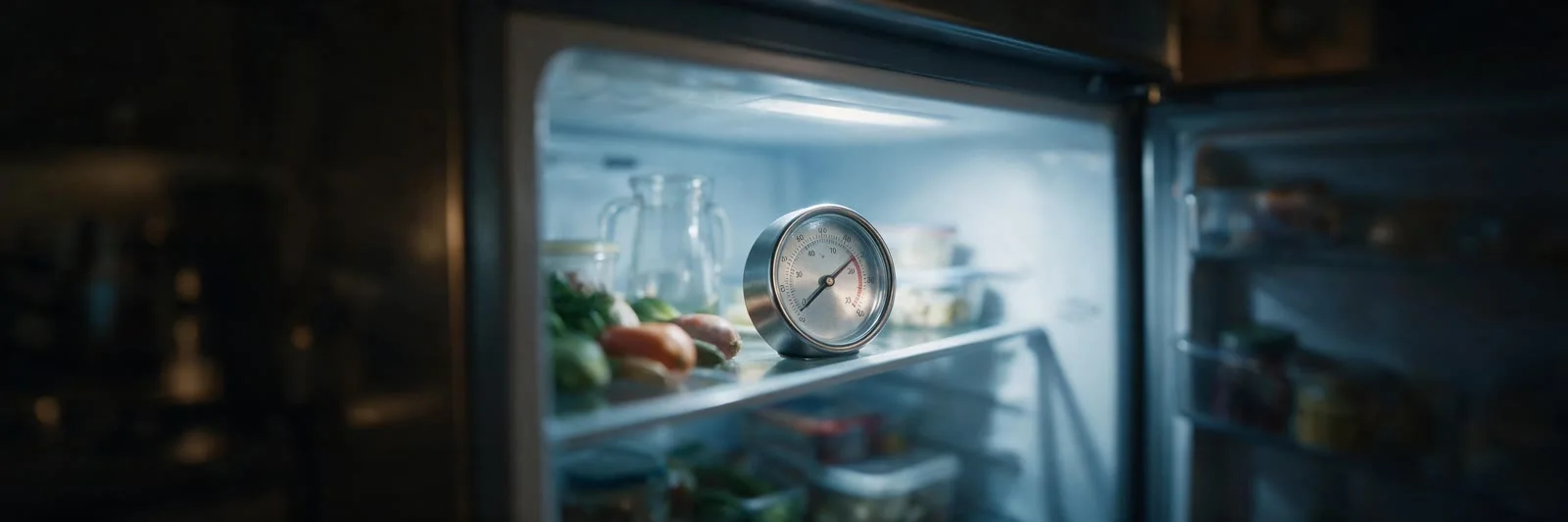
The fix is almost too simple: a basic refrigerator thermometer removes the guesswork.
Place the thermometer in the middle of the refrigerator and leave it for 5 to 8 hours before checking, as the FDA recommends. If the temperature is above 4°C, adjust the refrigerator temperature control to a lower setting and check again after another 5 to 8 hours. The same principle applies to your freezer, where the FDA recommends −18°C (0°F) or below.
A simple target:
- Fridge: 4°C or below
- Freezer: −18°C or below
Remember that 4°C is a target, not a magic cut-off. Within the manufacturer’s recommended range, colder temperatures generally slow the growth of many bacteria more effectively.
A few habits make the biggest difference once you know your real temperature:
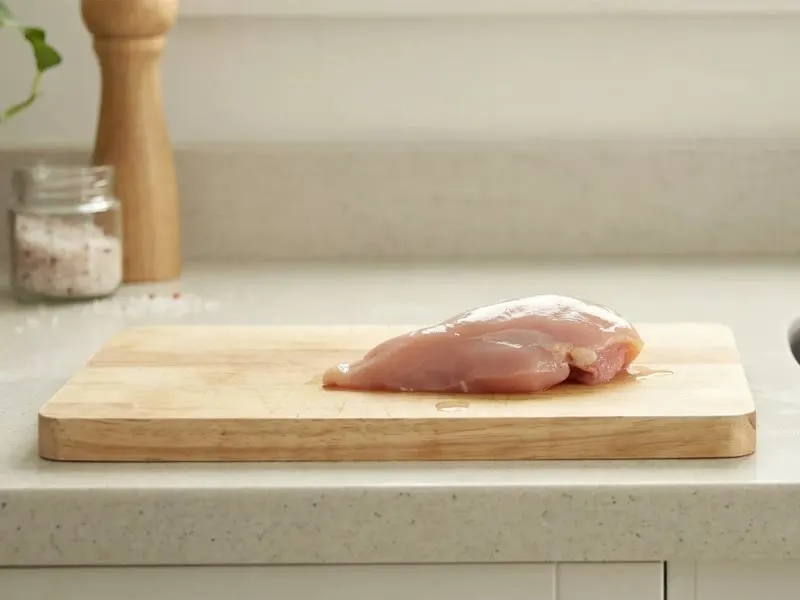
- Keep raw meat, poultry and fish on the lowest shelf, securely wrapped or in a sealed container, so raw juices can’t contaminate other food.
- Store ready-to-eat foods — leftovers, dairy and prepared meals — away from raw ingredients.
- Avoid overpacking the fridge. Blocking the circulation of cool air can interfere with proper cooling.
- Keep the refrigerator door closed as much as possible and avoid unnecessary opening.
- Don’t rely on smell or appearance alone. Harmful bacteria don’t necessarily change how food looks, smells, or tastes.
If your fridge is running warm
A reading above 4°C isn’t necessarily cause for panic, but it’s worth investigating:
- Check that the door is sealing properly and closing all the way.
- Make sure the fridge isn’t overpacked or blocking internal airflow.
- Keep highly perishable foods in a consistently cold area of the fridge while you troubleshoot the temperature.
- Adjust the temperature control and recheck after several hours.
- If the temperature remains above 4°C after adjusting, the appliance may need servicing.
One more thing: refrigeration can’t undo time
A cold fridge can slow bacterial growth, but it can’t reverse what happened while food was sitting at an unsafe temperature. FDA guidance recommends not leaving perishable food at room temperature for more than two hours — or one hour in very hot conditions — and refrigerating cooked and perishable food promptly. Putting food back into the fridge after it’s spent too long at room temperature doesn’t make it safe again.
Refrigeration isn’t a switch between “safe” and “unsafe” — it’s a rate. The colder your fridge actually is, within reason, the more slowly many bacteria can multiply.
Temperature is one part of food safety, not the whole story. Cross-contamination, storage time and how food was handled before it reached your fridge all matter too.
But temperature is one of the simplest factors to control — and one that many people never actually measure. One inexpensive thermometer and a few hours of checking can remove that guesswork.
Measure, don’t guess.